You know that moment when you’re calling your dog, and they just stare at you blankly—or worse, casually trot in the opposite direction? Yeah, we’ve all been there. Your voice is just noise to them sometimes, but your hands? That’s a different story. Dogs read body language way better than they process human vocabulary. Here’s the secret sauce: pairing every verbal cue with a distinct hand signal taps into your dog’s natural visual strengths. It’s like upgrading from a dial-up connection to fiber-optic internet for their brain. And the best part? You can train these 10 commands without hiring a $200-an-hour behaviorist. Grab some treats, clear your throat, and let’s turn your pup into a hand-signal-reading genius.
Why Hand Signals Beat Words Every Time
Let’s get scientific for just a second (I promise it’s painless). Dogs don’t naturally understand English, Spanish, or Klingon. They understand physical cues, posture, and movement. When you say “Sit” 50 times in a row, it becomes white noise. But when you raise your hand in a specific way, that visual sticks. Hand signals cut through the noise—literally. If you’re at a busy dog park, your voice gets lost in the wind and barking. Your hand signal cuts through like a beacon. Plus, as dogs age and lose their hearing, those hand signals become a literal lifeline for communication. IMO, every single dog should learn hand signals, even if they can hear perfectly fine. It’s just good insurance.
Training Basics: The Treat Triangle
Before we jump into the commands, let’s establish the ground rules. You need a reliable method, and I swear by the “Treat Triangle.” It’s simple:
- Lure – use a treat in your hand to guide your dog’s nose into the position.
- Mark – the instant they do it, say “Yes!” or click your clicker.
- Reward – give them that treat.
Once they consistently follow the lure, you fade the treat from your hand and transition to the empty-handed hand signal. Then you reward with a treat from your other hand. It takes patience, but it works like magic. Never skip the marking step—that “Yes!” tells them exactly what earned the cookie.
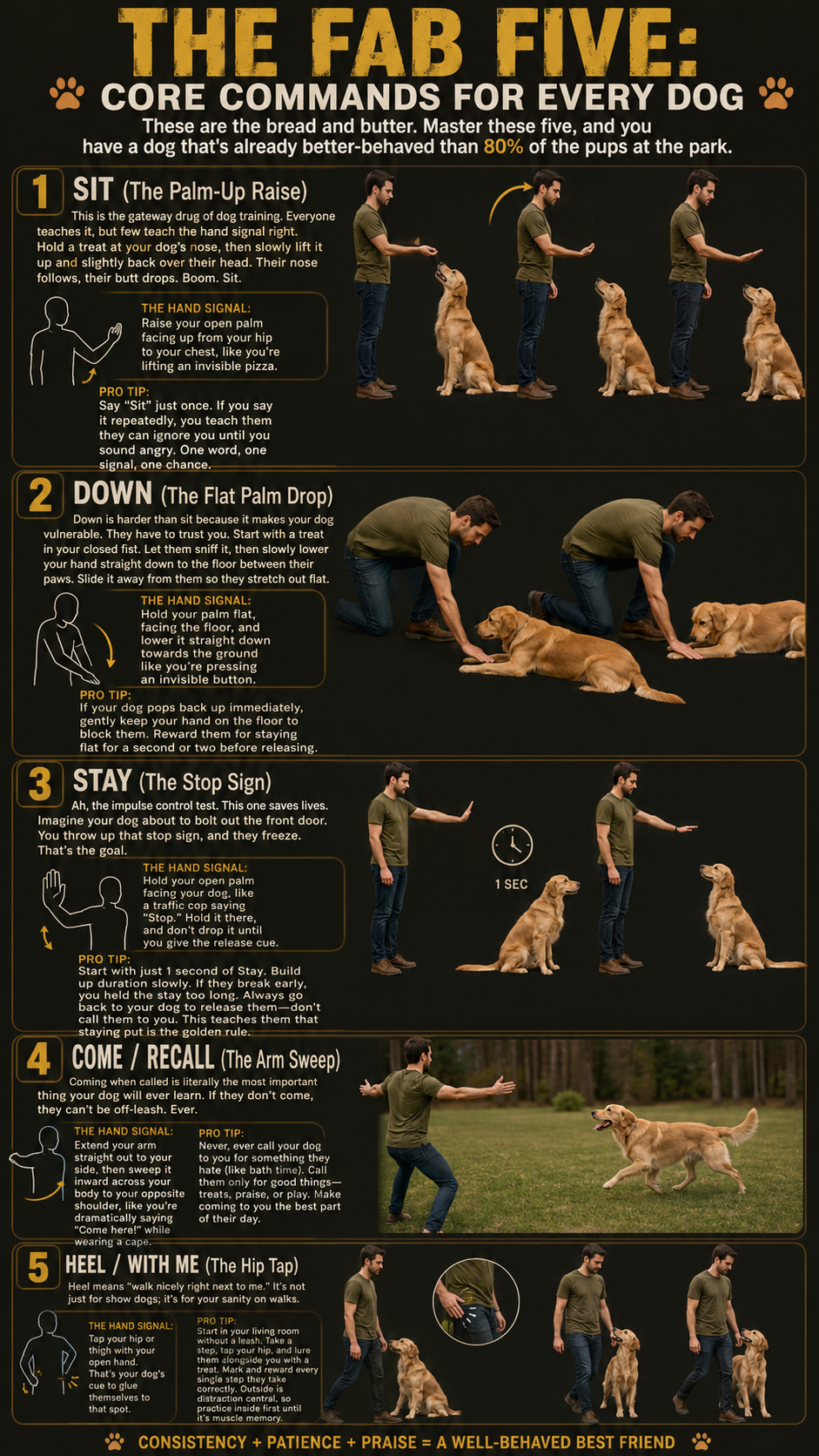
The Fab Five: Core Commands for Every Dog
These are the bread and butter. Master these five, and you have a dog that’s already better-behaved than 80% of the pups at the park.
1. Sit (The Palm-Up Raise)
This is the gateway drug of dog training. Everyone teaches it, but few teach the hand signal right. Hold a treat at your dog’s nose, then slowly lift it up and slightly back over their head. Their nose follows, their butt drops. Boom. Sit. The Hand Signal: Raise your open palm facing up from your hip to your chest, like you’re lifting an invisible pizza. It’s a universal “Sit” signal. Pro Tip: Say “Sit” just once. If you say it repeatedly, you teach them they can ignore you until you sound angry. One word, one signal, one chance.
2. Down (The Flat Palm Drop)
Down is harder than sit because it makes your dog vulnerable. They have to trust you. Start with a treat in your closed fist. Let them sniff it, then slowly lower your hand straight down to the floor between their paws. Slide it away from them so they stretch out flat. The Hand Signal: Hold your palm flat, facing the floor, and lower it straight down towards the ground like you’re pressing an invisible button. Pro Tip: If your dog pops back up immediately, gently keep your hand on the floor to block them. Reward them for staying flat for a second or two before releasing.
3. Stay (The Stop Sign)
Ah, the impulse control test. This one saves lives. Imagine your dog about to bolt out the front door. You throw up that stop sign, and they freeze. That’s the goal. The Hand Signal: Hold your open palm facing your dog, like a traffic cop saying “Stop.” Hold it there, and don’t drop it until you give the release cue. Pro Tip: Start with just 1 second of Stay. Build up duration slowly. If they break early, you held the stay too long. Always go back to your dog to release them—don’t call them to you. This teaches them that staying put is the golden rule.
4. Come / Recall (The Arm Sweep)
Coming when called is literally the most important thing your dog will ever learn. If they don’t come, they can’t be off-leash. Ever. The Hand Signal: Extend your arm straight out to your side, then sweep it inward across your body to your opposite shoulder, like you’re dramatically saying “Come here!” while wearing a cape. Pro Tip: Never, ever call your dog to you for something they hate (like bath time). Call them only for good things—treats, praise, or play. Make coming to you the best part of their day.
5. Heel / With Me (The Hip Tap)
Heel means “walk nicely right next to me.” It’s not just for show dogs; it’s for your sanity on walks. The Hand Signal: Tap your hip or thigh with your open hand. That’s your dog’s cue to glue themselves to that spot. Pro Tip: Start in your living room without a leash. Take a step, tap your hip, and lure them alongside you with a treat. Mark and reward every single step they take correctly. Outside is distraction central, so practice inside first until it’s muscle memory.
The Safety Superheroes: Commands That Prevent Emergencies
These commands aren’t just cool—they can literally save your dog’s life.
6. Leave It (The Closed Fist)
This means “Don’t touch that chicken bone on the sidewalk.” It’s impulse control on steroids. The Hand Signal: Hold a closed fist (treat inside) out in front of your dog. Let them sniff, lick, and paw at it. The moment they back off even an inch, mark and reward them with a treat from your *other* hand. Don’t open the fist. Pro Tip: Once they understand the game, drop a treat on the floor and cover it with your hand. Say “Leave it.” When they stop trying to get it, reward them with something even better. They learn that ignoring the thing on the floor gets them a super-sized prize.
7. Drop It (The Point)
They’ve got your favorite shoe. What do you do? Chase them? No, that’s a game. You need a solid “Drop It.” The Hand Signal: Point your index finger at the object in their mouth (or at the ground). Pair it with a firm “Drop.” Pro Tip: Trade them. Offer a high-value treat in exchange for the item. They drop the shoe to eat the cheese. You pick up the shoe. It’s a transaction, not a confrontation. Never pry their jaws open unless it’s life-threatening—you’ll create a resource-guarding monster.
8. Place / Go to Bed (The Point and Aim)
This is the “go to your spot” command. When the pizza delivery guy rings the bell, “Place” sends them to their mat instead of jumping on the visitor. The Hand Signal: Point with your whole hand (index and middle finger together) towards their bed or mat. Like you’re showing them exactly where to go. Pro Tip: Start with the mat right next to them. Toss a treat on it and say “Place.” Once they understand, move the mat further away. Eventually, they’ll run to their bed from across the room just because you pointed.
The Bonus Tracks: Extra Polish
You have the big eight. Let’s add two more for that “wow” factor.
9. Watch Me / Focus (The Finger to the Eye)
This is the reset button. If your dog is losing their mind at the park, “Watch Me” brings their attention back to you. The Hand Signal: Place your index finger between your eyes. Or, point to your own eye. It tells them, “Look at my face.” Pro Tip: Whenever they make eye contact naturally, mark and reward. You want them to offer you their focus willingly. Once they do, you can ask for it with the signal.
10. Settle / Relax (The Flat Palms Down)
This is the “chill out” command. It’s a slow, calming gesture that tells them to stop bouncing off the walls. The Hand Signal: Place both hands flat, palms down, and gently push them towards the floor. Use a calming tone—almost a whisper. Pro Tip: You can only train this when they are already slightly calm. You can’t train “Settle” when they are in full zoomie mode. Wait for a lull, say “Settle,” and reward them for lying down quietly.
The Golden Rules of Training (Read This Before You Start)
You have the commands, but how you execute matters more than the signal itself.
Keep Sessions Short
A puppy’s attention span is measured in seconds. Train for 5 minutes, three times a day. Five minutes of focused training beats an hour of frustrated repetition. Always end on a win—even if that win is just “Sit.” Happy dogs learn faster.
Be Ridiculously Generous with Rewards
In the beginning, treat every single successful response. I’m talking a treat per second for “Stay.” As they get better, you taper off the treats, but you never stop rewarding them entirely. Praise, play, or a random treat keeps them guessing and engaged.
Be Consistent with Your Signals
If you use an open palm for “Stay” on Monday and a closed fist on Tuesday, you’re confusing your dog. Pick a signal and stick to it forever. FYI, I recommend teaching your family the exact same signals. If everyone uses a different “Sit,” the poor dog will think you’re all speaking different languages.
FAQ’S
My dog only responds when I have treats. What do I do?
Ah, the “treat whore” phase. This is normal. You need to wean them off the treat lure gradually. Start hiding the treats in your pocket. Give the hand signal, and if they do it, reach into your pocket *after* they perform. They should learn that the action earns the treat, not the sight of the treat. Also, start rewarding with praise or a toy sometimes. Mix it up so they never know what’s coming.
What if my dog is deaf? Can I just use hand signals?
Absolutely. Deaf dogs thrive on hand signals. In fact, this article is perfect for you. Just skip the verbal cues and go straight to the visual signs. Use a flashlight or a gentle foot stomp (vibration) to get their attention first, then give the signal. You’ll find they are actually more attentive than hearing dogs because they have to watch you.
How long does it take to teach one command?
For a basic “Sit”? Some puppies get it in 5 minutes. For a solid “Stay” under distraction? That can take weeks. Don’t rush the process. Each dog learns at their own pace. Compare your dog to themselves yesterday, not to your neighbor’s Instagram-famous Golden Retriever.
Can I use the same signal for two different commands?
Nope. That’s a recipe for disaster. Each command needs a unique, distinct signal. If you use a flat palm for “Down” and also for “Stay,” your dog will just guess which one you mean. And they’ll guess wrong.
My dog knows the verbal command but ignores the hand signal. Why?
You probably introduced the verbal cue first. Many people do that. It’s fine. Simply go back to luring with the hand signal while saying nothing. Say the word *after* they do the action. This pairs the visual with the movement, and eventually, the visual takes over.
Communication is Everything
Here’s the honest truth: your dog wants to understand you. They spend their entire lives trying to read your mood, your posture, and your energy. Teaching them hand signals isn’t just about obedience—it’s about giving them a clear, consistent language so they don’t have to guess. The less guessing, the less anxiety, and the more confident your dog becomes. You don’t need a cape or a whistle. You just need your hands, some cheese, and a bit of patience. Start with “Sit” today. Add “Stay” tomorrow. Within a month, you’ll have a dog that watches your hands like a hawk and follows you anywhere. And when they nail that perfect recall at the dog park while everyone else is chasing their mutts? You’ll feel like a rockstar. Now go train. And remember—it’s supposed to be fun. If you’re frustrated, take a break. Your dog picks up on that. Keep it light, keep it positive, and watch your puppy turn into that “good dog” you always dreamed of.