Let me guess—you got a dog to enjoy relaxing walks, but instead, you’re being dragged down the sidewalk like a water skier behind a speedboat. Your shoulder hurts, your arm is stretched three inches longer, and your dog is basically giving you an upper body workout you never signed up for. Here’s the truth: pulling works for your dog. Every time they lunge forward and you follow, you just taught them that pulling gets them where they want to go faster. But we’re about to flip that script completely. I’m going to show you how to stop leash pulling with just five minutes of focused training a day—no prong collars, no shock devices, and definitely no yanking your dog’s neck off.
The Mindset Shift: You’re Not a Mule
Before we get into the mechanics, you have to change your mental approach. Most people treat walks like a race to get from point A to point B. Your dog treats walks like a sensory explosion of smells, squirrels, and that one bush every other dog in the neighborhood has peed on. The walk belongs to both of you, not just your dog. You aren’t a taxi service for their nose. You’re the leader, and leaders don’t get pulled. The moment you accept that the walk isn’t about distance but about quality, everything changes. If it takes you 20 minutes to go half a block, that’s a win. Your dog needs to learn that you control the pace, not their curiosity.
Why “Heel” Commands Usually Fail
You’ve probably tried the “heel” thing. You stand there, holding a treat, saying “Heel!” while your dog ignores you to investigate a discarded french fry. Why does this happen? Because you taught “heel” in your living room with zero distractions, and now you’re expecting it to work on Main Street with a pack of pigeons. Proofing is everything. Training in a quiet room is step one. Step two is the driveway. Step three is the sidewalk. You have to layer in distractions slowly, or you’re setting your dog up to fail. And honestly, “heel” is actually a pretty advanced command. For now, we’re just focusing on “stop pulling” and “pay attention to me.”
The Game Changer: The “Be a Tree” Method
This is the simplest, most effective technique I know, and it requires exactly zero treats to start. It’s called “Be a Tree,” and it exploits the one thing your dog desperately wants: forward movement.
Here’s How It Works
The second your dog hits the end of the leash and starts pulling, you stop. Dead stop. Don’t yank back, don’t say “No,” just stand there like a statue. Yes, it feels ridiculous. Yes, the neighbors will wonder why you’re frozen mid-stride. Wait. Your dog will eventually look back at you like, “Uh, why aren’t we moving?” The moment they look back or take even one step towards you, you mark it with a “Yes!” and you move forward again. Forward movement is the reward. You are literally teaching them that tension in the leash equals zero progress, while a loose leash equals adventure time. It’s boring for you, but it’s a powerful lesson. In the beginning, you might stop 50 times in a single block. That’s fine. Your dog will get it eventually because they don’t want to stand still any more than you do.
When They Pull, Just Pivot
If your dog is super determined and staring into the distance, completely ignoring you, turn around and walk in the opposite direction. Don’t jerk the leash. Just pivot and start walking the other way. Your dog will have to catch up. The second they catch up and the leash goes slack, mark and continue in this new direction. They learn that following you is the only way to get anywhere fun.
The “5-Minute Miracle” Daily Routine
You don’t need to spend hours on this. Five focused minutes a day beats a 45-minute walk where your dog practices pulling the entire time. Here is your exact daily routine.
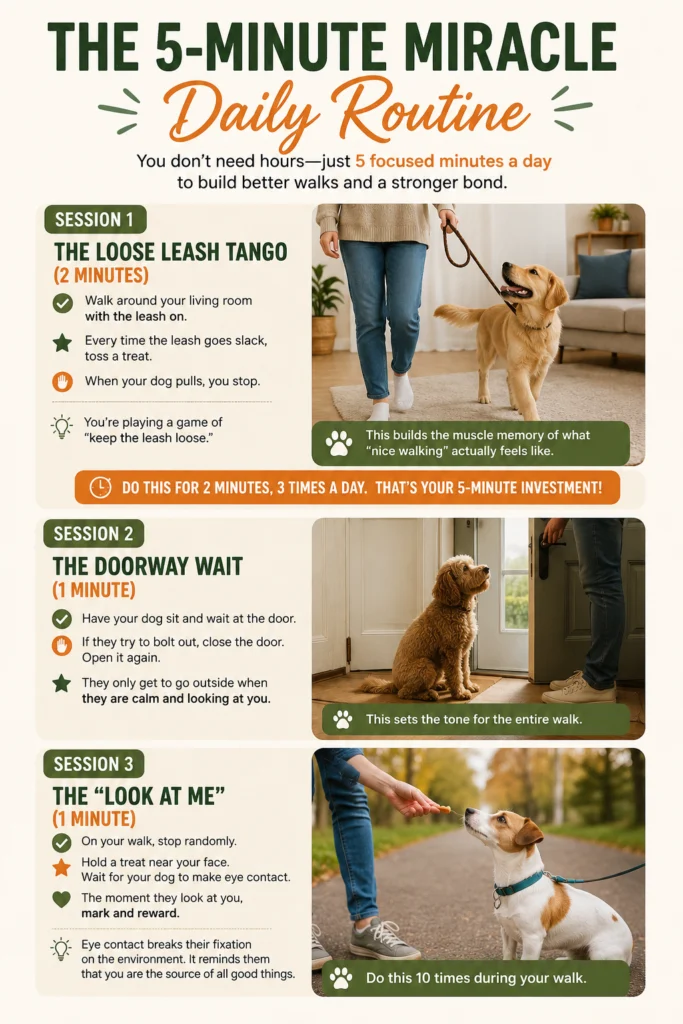
Session 1: The Loose Leash Tango (2 Minutes)
In your living room with the leash on, just walk around. Every time the leash goes slack, toss a treat. When your dog is walking nicely, the treats rain from the sky. When they pull, you stop. You’re basically playing a game of “keep the leash loose.” This builds the muscle memory of what “nice walking” actually feels like. Do this for two minutes, three times a day. That’s your five-minute investment.
Session 2: The Doorway Wait (1 Minute)
The walk starts before you even step outside. Have your dog sit and wait at the door. If they try to bolt out, close the door. Open it again. They only get to go outside when they are calm and looking at you. This sets the tone for the entire walk.
Session 3: The “Look at Me” (1 Minute)
On your walk, stop randomly. Hold a treat near your face. Wait for your dog to make eye contact. The moment they look at you, mark and reward. Eye contact breaks their fixation on the environment. It reminds them that you are the source of all good things. Do this 10 times during your walk.
Equipment: Tools That Help (and Don’t Hurt)
Let’s talk gear because the right equipment can make this process way less painful for both of you. But beware—most tools are not magic bullets.
The Harness Debate
I’m not a fan of attaching the leash to the back ring on a harness. That basically turns your dog into a sled dog and encourages pulling. Front-clip harnesses are my jam. The leash attaches to the front of their chest. When they pull, they are turned back towards you. It doesn’t hurt them; it just redirects their momentum. It’s physics, not pain.
Say No to Choke Chains
Look, I know some trainers still use them, but in my opinion, they are outdated and dangerous. They can collapse a dog’s trachea. Plus, they rely on pain, not learning. We want a dog who walks nicely because they *want* to, not because they are afraid of choking. FYI, positive reinforcement is scientifically proven to be more effective and builds a better bond with your dog.
The “Inside Out” Method for Stubborn Pullers
Got a powerhouse like a Husky or a Lab that could pull a sled? This one’s for you. We need to work with their drive, not against it.
Premack Principle
This sounds fancy, but it’s simple: “Grandma’s rule.” You can have dessert after you eat your vegetables. In dog terms: you can sniff that fire hydrant ONLY after you walk nicely for 10 steps. Let your dog approach the thing they want (a tree, another dog, a fire hydrant) as a reward for loose-leash walking. Use their own desires to your advantage.
The “Sniffari” Break
This might sound counterintuitive, but give your dog dedicated sniffing time. Let them sniff for 30 seconds on a loose leash without pulling you anywhere. If they pull, you plant your feet and don’t move. They learn that they get to sniff, but they don’t get to drag you to the sniff. It’s a compromise they can accept.
What NOT to Do (The Mistakes Everyone Makes)
Let’s clear up the bad habits before they become permanent.
Don’t Play Tug of War
When your dog pulls, your natural instinct is to pull back. That’s a contest of strength, and they can win. You’re just turning the leash into a tug toy. You want a limp noodle, not a bungee cord.
Don’t Jerk the Leash
Correction collars rely on leash pops. Please don’t do this. It creates a negative association with the walk and damages your relationship. You want your dog to look at you happily, not fearfully anticipate a neck pop.
Don’t Give Up Too Early
Your dog will have bad days. Maybe a cat ran by, or there was a particularly smelly pile of leaves. That’s okay. If the session is going south, just go home and try again later. Never end a walk on a bad note if you can help it. Always try to get at least one successful loose-leash moment before you head back in, so they remember the “good” version.
FAQ’S
How long does it really take to stop leash pulling?
With daily 5-minute sessions, you’ll see noticeable improvement in about a week. However, full reliability in high-distraction environments takes months. Don’t rush it. Your dog’s lifetime habit of pulling won’t disappear overnight. Be patient, and celebrate small wins.
What if my dog is too strong for me to control?
Then you absolutely need a front-clip harness or a head halter (like a Gentle Leader). These give you leverage without pain. Also, practice your “Be a Tree” stops—you don’t need to be stronger than them; you just need to be more stubborn than them. Stand still and wait them out. They can’t pull you if you don’t move.
My dog pulls only at the beginning of the walk. Why?
That’s pure excitement. They’ve been cooped up all day, and they have an explosion of energy. A quick fix? Do a little “craziness” routine before the walk. Toss a ball in the yard for 2 minutes or do some sprinting in the driveway. Burn off that initial burst of adrenaline before you attach the leash. Then, the walk starts calmer.
Should I use a retractable leash?
Please don’t. IMO, retractable leashes are the enemy of loose-leash walking. They keep constant tension on the line, teaching your dog that pulling is normal. Plus, they are dangerous—they can cause burns and the lock mechanism can break. Use a standard 6-foot flat leash. That’s it.
My dog stops pulling inside, but the second we go outside, they forget everything. What gives?
It’s because you skipped the “proofing” step. You need to train in your yard, then the driveway, then the quiet sidewalk, then the busy street. You’re asking too much of them too fast. Go back a step and build the distraction level slowly. It’s not a bug; it’s a feature of the process.
Do I use treats on every single walk forever?
Eventually, no. The walk itself becomes the reward. But keep treats handy for the first few weeks. You’ll use them less and less until your dog responds to just your voice. However, I still carry a treat pouch on most walks because randomly rewarding a nice loose-leash walk keeps them guessing and engaged.
The Walk is a Conversation, Not a Battle
Here’s the bottom line: your dog isn’t pulling to annoy you. They are pulling because they are excited about the world, and they don’t know the rules yet. It’s your job to teach them calmly and consistently. The five minutes a day I’m asking for is a tiny investment compared to the 10+ years of peaceful walks you’ll have with your dog. Stop fighting the leash and start teaching the game. Every stop, every pivot, every eye contact moment builds a picture of how you want the walk to look. It’s not about controlling your dog; it’s about communicating with them. When you nail that first walk where your dog trots beside you with a loose leash, looking up at you happily, it’ll feel like you’ve discovered a superpower. You’ve got this. Grab that leash, channel your inner Zen master, and remember—the walk doesn’t start until the leash is loose. Now go enjoy your stroll.
Related Articles:
- How to Choose the Right Dog Insurance
- The Best Probiotics for Dogs with Digestive Issues
- How to Keep Your Dog Safe in the Summer Heat