Let’s cut to the chase—you didn’t get a Rottweiler because you wanted a lapdog. You got one because those massive heads, muscular bodies, and ridiculous loyalty are absolutely intoxicating. But here’s the thing nobody tells you when you’re swooning over those adorable puppy photos: Rottweilers are powerful, intelligent, and stubborn little monsters who will absolutely walk all over you if you don’t start training from day one.
I learned this the hard way with my own Rottie, Bruno. That sweet little potato grew into a 110-pound tank who thought he was a lapdog and that “come here” was just a suggestion. Cue the embarrassing moments where I was literally being dragged down the street by a dog who weighed more than I did. 😅
But here’s the good news: training a Rottweiler isn’t rocket science. It’s actually a lot like cooking a complex, multi-course meal—you need the right ingredients, a solid recipe, and a whole lot of patience. These six tips are your foolproof guide to raising a Rottweiler who’s the envy of the neighborhood (instead of the one who’s terrorizing it).
Ready to turn your little tank into a well-mannered gentle giant? Let’s get cooking!
1. The Starter Appetizer: Socialization from Day One
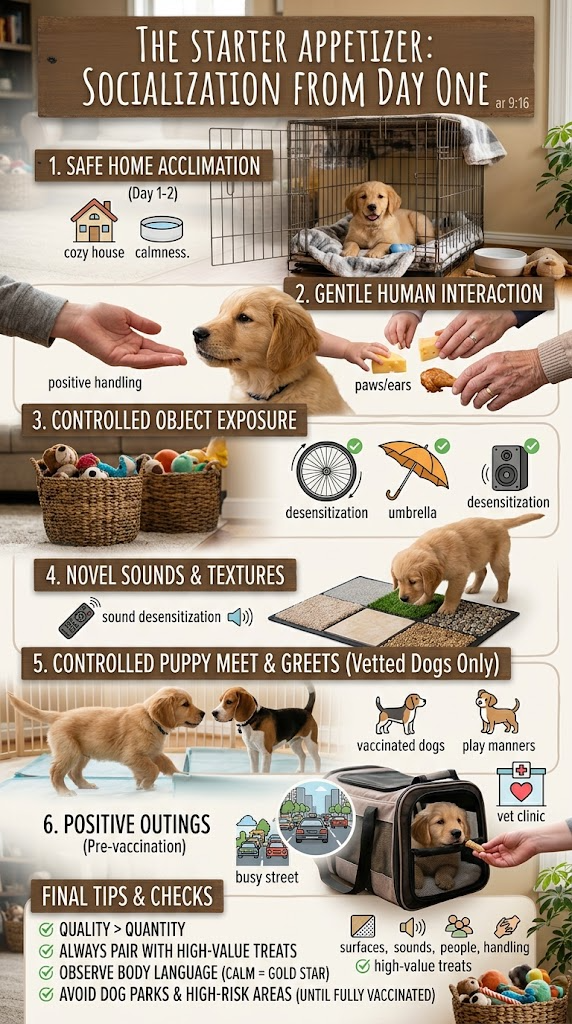
Why It’s Awesome: Socialization isn’t optional with Rottweilers. It’s the foundation of everything. Without it, you’re raising a ticking time bomb.
Ingredients:
- A puppy (8-16 weeks old is the sweet spot)
- A list of 100 new experiences (yes, 100—I’m serious)
- High-value treats (we’re talking real chicken, not that dry biscuit stuff)
- A calm, confident attitude (fake it till you make it)
- A carrier or sling for early outings
Step-by-Step Instructions:
- Start before they’re fully vaccinated. Use a carrier or sling to take them places. They don’t need to touch the ground to see, hear, and smell new things.
- Expose them to everything. Different surfaces (grass, concrete, tile), different sounds (vacuum, doorbell, traffic), different people (kids, elderly, people with hats), and different dogs (calm, vaccinated adults).
- Make every experience positive. Pair new things with treats. A lot of treats. Your puppy should think, “New thing? Cool, where’s my chicken?”
- Don’t overwhelm them. One new thing at a time. Three new things? That’s a recipe for an overwhelmed puppy. Keep it simple.
- Watch their body language. If those ears pin back or they try to hide, you’ve moved too fast. Back it up. This isn’t a race. It’s a marathon.
Why You’ll Love It:
Proper socialization prevents fear-based aggression down the line. Your Rottweiler will grow up thinking the world is a fun, treat-filled place rather than a scary monster factory. I took Bruno everywhere—Home Depot, outdoor malls, even my friend’s apartment building. By the time he was 6 months old, he’d seen more places than most people. And guess what? He’s bombproof now. Absolutely nothing phases him.
2. The Timing Taco: Start Leash Training Early
Why It’s Awesome: A Rottweiler who pulls on the leash is a nightmare. A Rottweiler who walks nicely is a dream. Start early and save your shoulders.
Ingredients:
- A properly fitted harness or collar (I prefer a front-clip harness for control)
- A 6-foot leash (retractable ones are the devil, fight me)
- High-value treats (keep these in a pouch on your hip)
- A quiet walking route (no distractions at first)
- Patience (your dog will test it)
Step-by-Step Instructions:
- Start indoors. Let your puppy drag the leash around the house to get used to the feeling. No pulling, just drag and explore.
- Pick a side. Decide whether you want them to walk on the left or right and stick with it. I prefer left—it’s traditional and keeps them away from traffic.
- Use the “let’s go” command. Every time you start walking, say “Let’s go!” in a happy voice. This becomes their cue to move with you.
- Stop when they pull. The second your Rottweiler hits the end of the leash, stop dead. Don’t move. Wait for them to look back at you. The moment they slack the leash, treat and move forward.
- Turn around frequently. In the early days, change direction often. This keeps your dog focused on you because they never know which way you’ll go next.
- Reward loose leash walking. When the leash is slack, treat, treat, treat. Make them think, “Walking nicely = chicken party!”
Why You’ll Love It:
Leash training prevents the “my dog is walking me” nightmare. It’s honestly one of the most important things you’ll teach your Rottweiler. I made the mistake of letting Bruno pull as a puppy because I thought “he’s just a baby.” Fast forward to him at 80 pounds, and I was literally being dragged. I had to completely start over. Learn from my mistake. Start early. 😉
3. The Reward Sauce: Use Positive Reinforcement (Not Force)
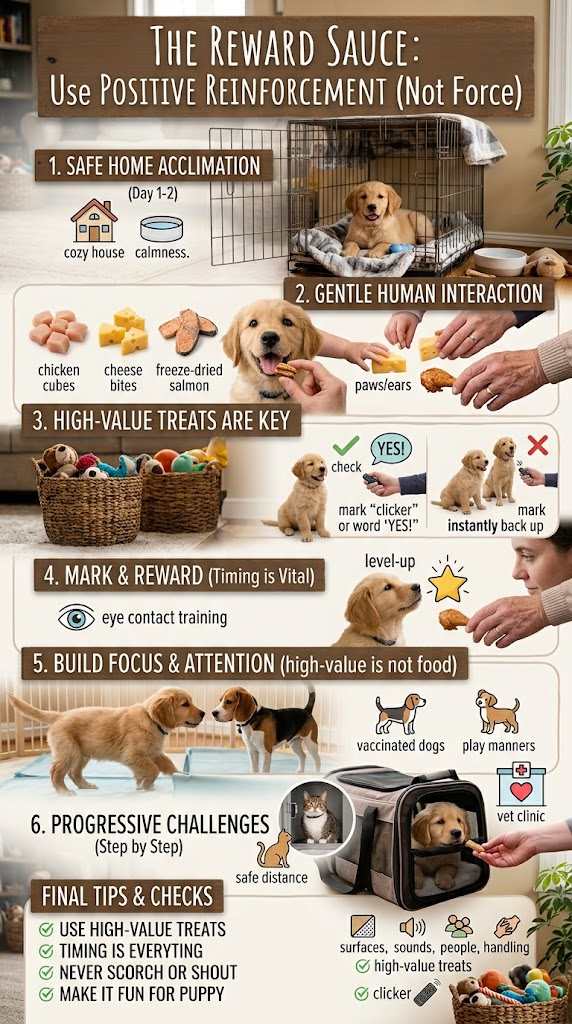
Why It’s Awesome: Rottweilers are sensitive souls. They don’t respond to harsh corrections. But they’ll do literally anything for a piece of cheese.
Ingredients:
- High-value treats (cheese, chicken, hot dogs, freeze-dried liver)
- A clicker or marker word (“Yes!” works great)
- Fast reaction time (you’ve got 1-2 seconds to mark the behavior)
- Enthusiasm (your dog needs to see you’re thrilled)
- A treat pouch (so you’re always ready)
Step-by-Step Instructions:
- Charge your marker. Say “Yes!” and give a treat. Do this 20 times. Your puppy should perk up when they hear it.
- Watch for good behavior. Is your dog sitting? “Yes!” + treat. Looking at you? “Yes!” + treat. Existing nicely? “Yes!” + treat.
- Capture the behavior you want. See them lying down quietly? Mark and reward. See them making eye contact? Mark and reward. You’re paying them to be good.
- Use food to lure behaviors. Hold a treat near their nose and move it back over their head—they’ll sit to follow it. Say “Sit!” the moment their butt hits the ground, then mark and reward.
- Phase out the treats gradually. Once they know the behavior, you can start rewarding every other time, then every third time. But keep the treats coming for the really important stuff.
Why You’ll Love It:
Positive reinforcement builds trust. Your Rottweiler will want to work with you because you’re the source of all good things. I used to think I had to “dominate” Bruno (eyeroll) until a trainer told me I was ruining our relationship. Once I switched to positive reinforcement, everything changed. He went from ignoring me to looking at me like I was the best thing since sliced cheese.
4. The Confidence Casserole: Teach Impulse Control
Why It’s Awesome: A Rottweiler with no impulse control is a disaster waiting to happen. A Rottweiler with impulse control is a respectful, polite companion.
Ingredients:
- High-value treats
- Patience (you’ll need a lot of this)
- A leash (for the “leave it” game)
- A variety of distractions (toys, other people, food on counters)
- A consistent routine
Step-by-Step Instructions:
- Start with the “sit to say please.” Your dog must sit before they get anything—food, toys, going outside, greeting people. Make sitting the price of admission.
- Teach “leave it.” Place a treat on the floor, cover it with your hand, and say “Leave it.” When they stop trying to get it, reward with a different treat from your hand.
- Work on “wait.” At doorways, at the car, at the food bowl—anywhere your dog wants to rush forward. Ask them to “Wait” and release them with “Okay!” This prevents door-dashing and bolting.
- Practice the “drop it” game. Have two toys. When they have one, show them the other. Say “Drop it!” the moment they release the first toy to grab the second. Then reward.
- Add distractions gradually. Start in a quiet room, then add the TV, then add another person, then try it outside. Always go back to basics when they fail.
Why You’ll Love It:
Impulse control makes your Rottweiler safe and manageable. It’s honestly like having a dog who can think before they act. When Bruno first started jumping on people, I was mortified. A 100-pound dog jumping on guests? Not a good look. But once we nailed impulse control, he became the most polite dog on the block. People actually compliment him now.
5. The “Yes” Menu: Master the Art of Obedience Commands
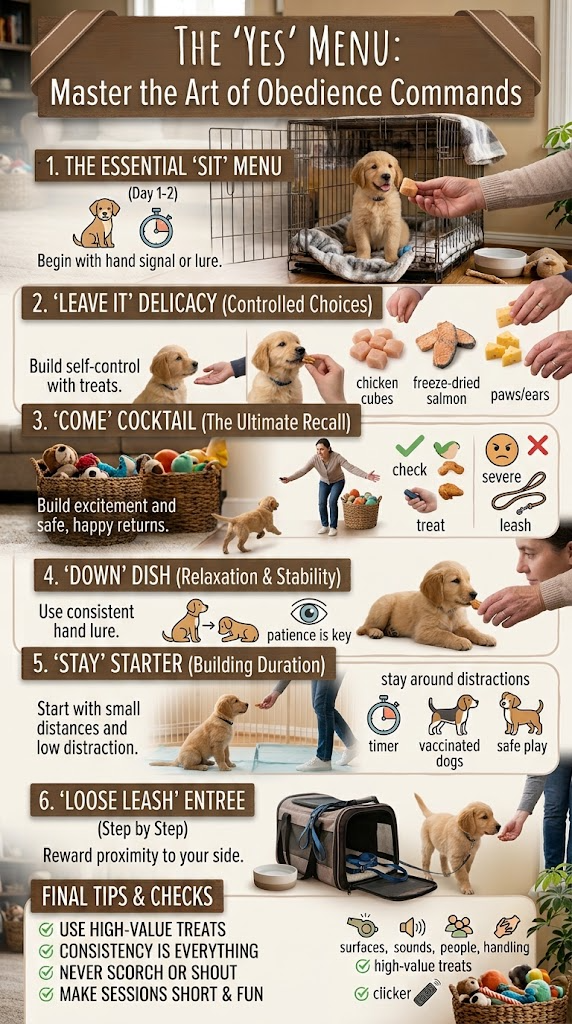
Why It’s Awesome: A well-trained Rottweiler is a joy to live with. These commands literally save lives—yours, your dog’s, and others’.
Ingredients:
- High-value treats
- A marker word
- A distraction-free environment (start here)
- A leash (for proofing commands)
- Consistency (everyone in the house must use the same words)
Step-by-Step Instructions:
- Start with “sit.” Hold a treat near their nose, move it back over their head. Their butt will hit the floor. Say “Sit!” mark, and reward. Repeat until they offer it without the lure.
- Add “stay.” Ask for a sit, then say “Stay” with a flat palm in front of their face. Take one step back. If they stay, return to them and reward. Gradually increase distance.
- Teach “down.” Lure them into a lying-down position. Hold the treat at their nose, slowly lower it to the ground, and slide it away from them. Their body will follow. Say “Down!” mark, and reward.
- Master “come.” This one’s critical. In a quiet room, call them with a happy voice: “Come!” When they run to you, throw a party. Treats, praise, play—make it amazing.
- Add “place” or “go to your mat.” Teach them to go to a specific spot and stay there. This is golden for when guests arrive or you need a moment of peace.
- Practice every day. Short sessions, 5-10 minutes each. Multiple times a day. Rottweilers learn fast, but they also get bored fast.
Why You’ll Love It:
Reliable obedience commands make living with a large dog completely manageable. You can take them anywhere and do anything. Bruno’s “come” command literally saved his life once when he slipped his collar near a busy road. I called him, and he turned around and ran straight back to me. I cried with relief. Teach your dog these commands. It’s not just about convenience—it’s about safety.
6. The Patience Pudding: Deal with Adolescence Like a Pro
Why It’s Awesome: Between 6-18 months, your sweet puppy turns into a rebellious teenager. This recipe helps you survive with your sanity intact.
Ingredients:
- Deep breaths (lots of them)
- Return to basics (start over if you have to)
- Extra exercise (a tired dog is a good dog)
- Mental stimulation (puzzle toys, training games)
- A sense of humor (you’ll need it)
Step-by-Step Instructions:
- Understand it’s normal. Your dog isn’t being difficult to spite you. Their brain is literally being rewired. They’re going through puberty, and it sucks for everyone.
- Go back to training 101. They forgot their commands? It happens. Go back to the beginning and start over. No shame. This is how you reinforce learning.
- Increase exercise. A bored teenager is a destructive teenager. More walks, more playtime, more mental stimulation. A tired Rottweiler is a well-behaved Rottweiler.
- Don’t take it personally. Your dog is going to ignore you. They’re going to test boundaries. They’re going to be a jerk sometimes. Don’t let it break your spirit.
- Stay consistent. If anything, be MORE consistent during adolescence. Clear rules, clear expectations, clear consequences (positive reinforcement, of course).
- Hire a trainer. If you’re struggling, get professional help. There’s no shame in bringing in reinforcements. I wish I’d done this sooner with Bruno.
Why You’ll Love It:
Surviving adolescence sets the stage for a wonderful adult dog. Your Rottweiler will come out the other side as a calm, confident, well-adjusted adult. Bruno was a nightmare at 8 months—he forgot his name, he jumped on counters, he was a menace. But I stuck with it, and now he’s the most wonderful 3-year-old. He’s calm, he’s respectful, and everyone loves him. The hard work pays off. Trust me.
BONUS: The Training Smoothie (What to Do When You’re Overwhelmed)
Why It’s Awesome: Sometimes you need a quick reset. This is your emergency smoothie.
Ingredients:
- A quiet room
- A frozen Kong or long-lasting chew
- 10 minutes of calm
- A list of small wins (to remind yourself you’re doing okay)
- Self-compassion (you’re doing your best)
Step-by-Step Instructions:
- Give your dog a Kong. Chewing reduces stress for dogs. Let them settle with something to do.
- Take a deep breath. You’re not failing. Training is hard. Every owner struggles.
- Focus on one thing. Pick one command and work on it for 5 minutes. Just one. Master that one thing.
- Write down your wins. What went well today? Even if it was just “they sat nicely once,” write it down. Celebrate the small victories.
- Tomorrow is a new day. Training isn’t linear. There are good days and bad days. Tomorrow you’ll start fresh.
Why You’ll Love It:
Quick resets prevent burnout. You’re in this for the long haul. A Rottweiler lives 10-12 years. A few bad training days won’t ruin anything. Take care of yourself so you can take care of your dog.
Related Articles:
- 6 House-Training Steps That Work for Dachshunds
- 6 Socialization Tips for Raising a Well-Behaved French Bulldog
- 6 Siberian Husky Behavior Problems
A Note About Rottweiler Stereotypes (Because We Need to Talk About It)
Let’s address the elephant in the room—Rottweilers have a reputation. People cross the street when they see you. People make assumptions. Your dog will be judged before they’ve even done anything wrong.
This is why training is so important. A well-trained Rottweiler who sits politely, walks nicely, and ignores distractions is the best ambassador for the breed. My Bruno has changed so many minds. People who were terrified of him end up wanting to pet him because he’s so calm and friendly.
Your training isn’t just for you—it’s for every Rottweiler out there. Good training helps break stereotypes.
FAQ’s
Raising a Rottweiler is not for the faint of heart. It’s a lot of work. They’re powerful, they’re stubborn, and they’ll test every ounce of your patience. But I promise you this—if you put in the work, you’ll end up with the most loyal, loving, incredible dog you’ve ever had.
That moment when your 100-pound Rottie gently rests their head on your lap? When they lean into you like they trust you with their whole heart? It’s magical. It’s all worth it.
Remember:
- Training never stops. Even when they know commands, keep practicing. Keep reinforcing.
- Your dog wants to please you. They just need clear communication.
- Have fun with it. Training should be a joy, not a chore. If you’re not enjoying it, something needs to change.
- Don’t compare your dog to others. Every Rottweiler is different. Some learn faster, some need more time. Go at your own pace.
You’ve got this. I believe in you. And your Rottweiler believes in you too. Now go grab those treats, get that leash, and get to work. A well-trained Rottweiler is worth every single second of effort.
And hey, if you’re having a rough day with your giant baby, just remember—they’re going to be your best friend for the next 10-12 years. The struggles of the first year are a small price to pay for that kind of loyalty. 🐾
P.S. If your Rottweiler is acting out, rule out medical issues first. Pain can cause behavior problems. My friend’s Rottie was being “stubborn” and it turned out he had a ear infection. Always check with your vet.
P.P.S. Invest in a good leash and harness. You’ll thank me when your Rottie sees a squirrel and you’re not dragged into traffic. I use a front-clip harness and it’s a game-changer.
P.P.P.S. Don’t skip the socialization. I know it’s exhausting, but it’s the most important thing you’ll ever do for your dog. A poorly socialized Rottweiler is dangerous. A well-socialized Rottweiler is a joy.